


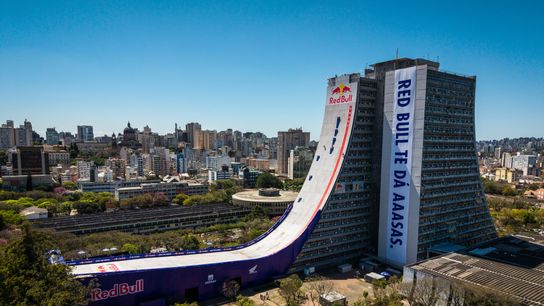
Brazilian skateboarding legend Sandro Dias has etched his name into history once again, shattering two Guinness World Records™ by dropping in from a 22-storey government building in Porto Alegre, southern Brazil. The 50-year-old Red Bull athlete, known as one of the sport’s most fearless pioneers, skated from a height of 70 meters down the distinctive quarterpipe-shaped curve of the Centro Administrativo Fernando Ferrari building — a structure long mythologized in skate culture as the “Ultimate Skate Ramp.”
In a project dubbed Red Bull Building Drop, Dias hit a blistering top speed of 103.8 km/h, earning records for both the tallest drop-in on a skateboard and the fastest descent on a temporary quarter pipe. The feat was verified on-site by Guinness World Records™ officials and marked the culmination of more than a decade of speculation, memes, and fan-made videos that imagined the building’s curved design as a giant skate ramp.
Red Bull Content Pool
“This is a dream of more than 13 years that we’ve just achieved now, pushing the limits,” Dias said after completing his final descent. “The most important message I want to share is never give up on your dreams.”
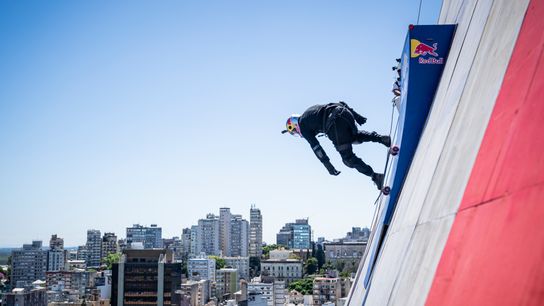
The final run lasted just eight seconds, but it was the product of ten months of grueling preparation. Dias trained with a 40kg vest on modified mega ramps to simulate G-forces, hitting speeds of over 136 km/h in runway tests to prepare for the strain of the descent. He also endured wind, height, and exposure training, as he was rappelled down from the building’s roof onto platforms at 55, 60, 65, and finally 70 meters for successive attempts. Each drop was a first-try success — but his final 70-meter plunge was never rehearsed in training, underscoring both his confidence and his willingness to skate into uncharted territory.
The building itself, weathered by decades of exposure, had to be outfitted with plywood panels to make the descent possible. MotoGP-style inflatable air fences lined the ramp, 1,800 foam cubes awaited him at the bottom, and Dias wore a full-face helmet and spine protector — safety gear rarely used in skateboarding. Outfitted in high-performance apparel from Prada Linea Rossa, Dias combined speed, protection, and aerodynamic efficiency with style, as luxury fashion met skate progression.
Dias experienced a peak of 3.9g during the descent — the equivalent of weighing nearly 280 kilograms in that moment — before coasting into the foam pit in one piece. “The training was harder than this,” he reflected. “That’s why I was so confident.”
Red Bull Content Pool
The drop wasn’t just a personal milestone but a cultural one. For years, the CAFF building’s quarterpipe silhouette sparked viral hoaxes and fingerboard recreations, even spawning a spoof YouTube clip 16 years ago. By turning the fantasy into reality, Dias bridged skateboarding’s folklore with its future, cementing his reputation as one of the sport’s most daring figures.
Tributes poured in from across the skateboarding world. “He’s always been going higher and faster than everybody,” said U.S. pro Ryan Sheckler, a longtime mentee and competitor. “And at 50 years old, to be seeing something like this… it just shows the skate in his heart.” Tony Hawk, another global icon, praised Dias for “jumping ahead about five times everyone else,” calling the feat a new benchmark in skateboarding’s constant progression.
For Dias, who in 2005 became the first skater to land a 900 at the X Games, this project represents not just another record, but a legacy-defining moment. “It’s not about seeking fame,” he said. “It’s about pushing the limits, creating opportunities, and giving visibility to skateboarding as a whole. This is something we should all celebrate together.”