
Mips, a helmet-based safety technology company has announced a partnership with Carey Hart.
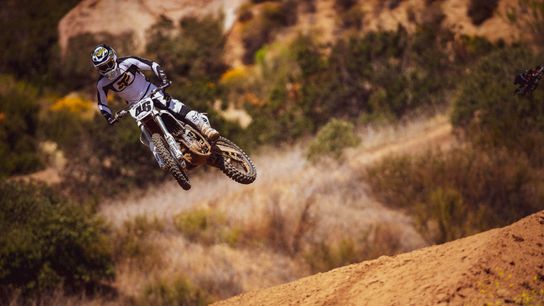
Carey Hart’s impact on the motorcycle industry spans decades. He is perhaps most known for being the first person to complete a backflip aboard a dirt bike 21 years ago, which helped push the sport of freestyle motocross into the mainstream.
Upon his retirement from competition, Hart transitioned into race team ownership, where he, partner Ricky Carmichael and rider Ken Roczen captured the 2016 AMA Pro Motocross Championship under the RCH Racing banner. Hart’s influence crossed over from off-road and into the hugely popular cruiser segment when he became an ambassador for Indian Motorcycles and introduced his popular philanthropic organization, The Good Ride.
Perhaps most importantly, Hart is a loving husband and devoted father to two children. Family serves as the cornerstone of all Hart’s endeavors and also serves as the foundation of his ambassadorship with Mips, where together this newfound partnership will aim to raise awareness around head protection and encourage the utilization of added safety in helmets.
“’Protect yourself, protect your family’ is a guiding principle that motivated me to get more involved with head protection and helmet safety,” said Hart. “As a freestyle competitor, racer, and lifelong rider, I know first hand that your choice of helmet can be a life-changing decision.”
Action Sports Today spoke with Carey and is the subject of this weeks, “Behind The Action."
AST: If you were to take all of the knowledge that you have amassed over your entire career, and you could go back and give your younger self some direction, where would you start?
CH: That is such a hard loaded question. I sit back and reflect on my life’s history when it comes to moto and my involvement in the sport. I would start by telling myself to keep the mental game strong because so much of this sport is mental. You have to be completely committed to the sport and even more granular, the trick. If you aren’t completely committed, you put yourself in danger.
AST: The sport has advanced in so many different ways from technology, to safety and even in the business side of the sport. Do you prefer having learned and developed your career as a pioneer of the sport of would you have rather come into it nowadays where much of the major advancements are established due to riders like yourself and others?
CH: I loved being a pioneer of the sport, but if I had to pick one aspect of that, I wish the technology and safety enhancements had been around back in my early 20’s. I took a lot of hits to the head. Had I had the technology that Mips provides, I think my head would be in better shape. However, I think my thoughts on this have evolved and changed over the years allowing me to be more in tune with my body due to all the injuries I have had so I am more in tune with the desire for safety first more now than I was back then. From helmets, to pads and braces and even boot technology are extending careers of racers and freestyle riders.
CH: Both of my kids ride BMX and Moto and my daughter rides horses too. Knowing how the technology in Mips displaces the energy that comes through the force of the impact helps to ease the stress of a parent knowing that crashes do happen. It is so important. It is not just about having a helmet, it is having a helmet that works to protect you in a multitude of ways and having a helmet with the Mips system in place allowing for that energy to be dispersed is so critical.
My brother died of a head injury racing for my race team 13 years ago so this hits close to home. I choose to protect those around me and having the opportunity to speak and represent a company such as Mips to help spread education and awareness is an important mission to me.
You learn lessons from injuries or death and that is unfortunately how the technology has advanced. But now, when you have the gear on, you become more cognizant of what part of your body is protected so you do not take unnecessary risk and you know how hard you can push it based off of knowing how protected you are.AST: Has the evolution of the sport reached a point that it should take a pause from progression or is the continued progression into bigger tricks only going to continue as long as the technology advances with it?
CH: In all aspects of action sports from dirt, water or snow, the great thing is that I feel both the technology and safety are progressing alongside the trick evolution. For a long time that was not the case. And more importantly, the athletes take the progression of the sport differently than in the early days. Today, when an athlete wants to push the trick to the next level, they do so with the trick, the ramp, the landing, the gear and the safety aspect in mind. In my day that was not the case. Being the first to do a backflip is one thing, but now there are double and even triple backflips and 1900 degree rotations on skis and snowboards. Physics is being pushed in the sport so the slams that an athlete can take now is heavier than it was for me but less impactful on the body because of enhancements like Mips.
But the issue remains in educating the every day consumer. An athlete who injuries themself is more aware of better gear than someone who is just buying a product on the shelf. There is a value in spending the extra money to have better technology on your body. All gear is not made the same and unfortunately, there are a lot of people out there that think it is. Speaking from just the moto side of things, most people go into a store with a set budget or graphic they like and that is what they shop for. They are not shopping for safety first. All helmets are not created equal. Mips has invested more than two decades of research into its technology and continues to make improvements to its patented safety system. The peace of mind and increased level of trust I feel whenever I strap on a Fox or Bell helmet equipped with Mips’ technology is something I hope all riders take advantage of. Just get a helmet that feature the yellow dot.AST: What else can be done to help educate the everyday consumer to invest the safety and technology rather than the price first?
CH: It will come. Now that athletes are using their platform to promote lessons they have learned. So as ambassadors continue to talk about the product, the generation that follows us on our social platforms now knows what to look for first. It is hard to teach an old dog new tricks. There is a faction of older riders that have set ways and bad habits. So by using my platform or other athletes using their platform to educate, the newer consumer or younger consumer will learn and then down the way they will educate their kids as well.
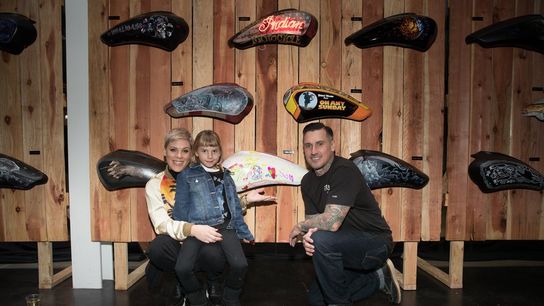
CH: Until my wife and I started dating over twenty years ago, I was not personally connected to the military, but my wife’s family is steeped in military service and I was educated on what happens when troops come home. For me, I always wanted to do a charity that was my own beyond Road to Recovery. It was hard to figure out how to do this while still having a motocross footprint. When I got involved with Indian Motorcycles, I began to notice the presence of veterans everywhere in the V-Twin community. The light bulb went on. That is how the Good Ride came about to raise money and give veterans another community to be involved in.
Every event we do just gets bigger and better and the satisfaction that comes from the day, completely validates the hard work that we put into it.
About Mips
The results of several studies conducted showed that the MIPS and SPIN helmets were more successful in reducing the risk of brain trauma and injuries by 42% and 54% respectively. Another study was published in May 2021 to determine the effectiveness of new bike helmet technologies in mitigating brain injuries caused by oblique forces.
The Mips safety system features a low-friction layer inside the helmet that allows a multi-directional movement of 10-15mm on certain angled impacts, intended to help reduce rotational force to the head.
What is Rotational Motion?
Rotational motion, in these cases, can be the result of an angled impact to the head. These impacts may result in an abrupt stop that can cause the brain to move or stretch.
Why is Rotational Motion Bad?
The brain is more sensitive to rotational motion than linear motion because it has shear properties similar to water or gel. When different parts of the brain move relative to each other as a result of rotational motion, the tissues can stretch, which can cause concussions or other brain injuries.
Where is the Mips Safety System Located in the helmet?
Mips is found inside the helmet, generally between the padding and the EPS foam protective layer. There are different Mips systems, but all consist of a low-friction layer between the helmet and the head.