


Today, on National Women in Sports Day, the spotlight turns toward the women who are shaping the future of athletics, competition and leadership across the world. In global motorsport, few figures embody that progress more powerfully than Silvia Bellot, Vice President of Sporting and Race Operations for the FORMULA 1 HEINEKEN LAS VEGAS GRAND PRIX.
Under the neon glow of the Las Vegas Strip, where one of Formula 1’s most ambitious street races unfolds, Bellot is responsible for ensuring that every on-track moment is conducted with safety, fairness and flawless execution. While fans see the spectacle of speed and sound, Bellot lives in the world behind it, the world of race control, operational precision, split-second decision making and the quiet infrastructure that makes the show possible.
Her journey to that position, however, began long before Las Vegas.
It began with a childhood shaped by racing.
“Motorsport has always been part of my family,” Bellot says. “I remember watching any type of racing at home during the weekends; Formula 1, MotoGP, the Dakar Rally, the Rally Monte Carlo. It was always there. My dad was a racing marshal as well, so motorsport was just part of our life.”
Growing up in Barcelona, she wasn’t just a fan, she was surrounded by the culture of competition. But it wasn’t until she was a teenager that something shifted from admiration into purpose.
“I would say when I turned 13 years old is when I consciously realized, ‘I’m stuck to it. I really want to be in this field,’” she recalls. “I didn’t want to just be a fan watching on TV. I wanted to do more than that.”
Her father took her to the racetrack in Barcelona, and what she witnessed that day changed everything.
“I watched the team working, and I absolutely loved it,” she says. “I saw a racing incident, and I saw how it was solved, how there was an infringement between drivers, and how they brought justice. And I remember thinking, ‘Wow. I love that. I want to be part of this sport.’”
From that moment on, she wanted to be involved in every way possible.
“I told my dad, ‘You need to bring me with you to any race.’ Obviously I couldn’t do too much at that time, but I was doing copies, being a gear runner, distributing documents with the teams. And since then, I was in love with the sport. I knew I wanted it to be part of my life.”
Those early experiences gave Bellot something rare: a grassroots understanding of racing operations from the inside out.
She didn’t enter motorsport at the top. She learned it from the ground level, and that foundation would shape the leader she would become.
“I started as a runner when I was very young,” she explains. “It sounds small, but it allowed me to understand which documents are necessary, the different roles, how everything is created. Knowing the sport from the grassroots helped me transition into the role I am in now.”
Even as a teenager, she was learning how to manage responsibility and pressure, skills that now define elite race operations.
“I remember being in high school and thinking, ‘I need to make sure I fulfill my responsibilities at school so I can go to the race on the weekend,” she says. “So I always got used to working under pressure and multitasking. Back then it seemed small, but now you just scale it up.”
Bellot’s career would scale dramatically.
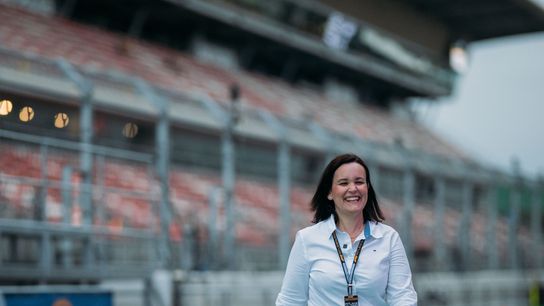
She rose through the ranks to become the first female FIA steward in Formula 1, and later the first-ever female FIA Race Director, leading sporting oversight across Formula 1, Formula 2, Formula 3, IndyCar and other international championships.
Yet even with those achievements, she admits she never fully imagined she would reach the position she holds today.
“When I was young, around 18, I knew I wanted to be in the sport,” she says. “But unfortunately, there were not many role models. All the people I could see were men. I didn’t think there was really a path for me.”
At the time, her dream felt ambitious enough.
“My goal was to be an F1 steward, and that was already dreaming big,” she says. “I never thought I could reach a position like I am today. I’m glad I didn’t stop there. I’m really glad I continued.”
Now, she stands at the center of one of the most complex race operations in the world: Las Vegas.
Unlike traditional permanent circuits, the Las Vegas Grand Prix must transform one of the busiest city environments on Earth into a Formula 1 track, and then return it back to normal life almost immediately.
“Here in Vegas, we’re pioneers,” Bellot says. “We’re a street circuit in one of the busiest streets in the world, so that’s a challenge in itself. In order to allow our community to go back to work and deal with their duties every day, we open and close the track every single day in 42 different areas.”
The scale of that operation is staggering.
“It takes hundreds of people. It takes a lot of machinery,” she explains. “And we do that in less than two hours, sometimes an hour and 30 minutes. That’s never been done anywhere else in the world.”
Before the inaugural Las Vegas Grand Prix, many doubted it could be achieved.
“No one thought we could do that,” she says. “Everyone said, ‘You guys are crazy. What you’re trying to do is not possible. You need to close the track for the entire event.’”
But Bellot and her team believed Las Vegas could set a new standard not just for spectacle, but for partnership with the the county and local stakeholders.
“We wanted to give back to our community, to be good neighbors and good hosts,” she says. “And we have delivered it every year.”
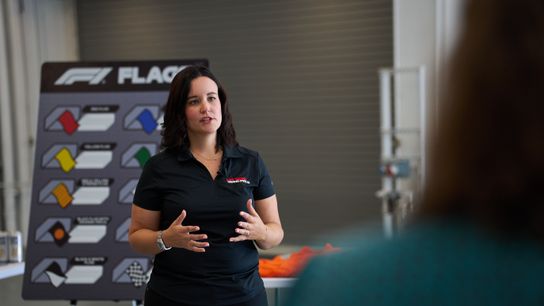
While her full-time department is small, the race-week footprint expands to nearly a thousand people, including marshals, officials and operational staff.
“In race operations, we have four people full time,” she explains. “But when we get closer to the race, the number increases hugely. We work with about 600 marshals, plus additional race officials, another 200 people, so almost 1,000 people involved.”
It is a testament not only to logistics, but to leadership.
And for Bellot, leadership also means visibility because she knows what it meant to grow up without seeing women in these roles.
“Having women not just in race control, but in all areas of the sport engineers, drivers, mechanics it changes what the next generation believes is possible,” she says. “If there is a woman in those positions, they can also be there.”
Being the first often comes with weight, but Bellot sees that weight as responsibility.
“Sometimes when you’re the first one, you have to break that glass ceiling,” she says. “You go through situations that are challenging, uncomfortable. But I knew if I didn’t take that opportunity, it might take another 10, 15, 20 years for another woman to have that chance.”
So she kept moving forward not only for herself, but for those coming behind her.
“I’m doing it for me,” she says, “but also for the ones that come in behind.”
On National Women in Sports Day, Silvia Bellot’s story is more than a milestone. It is a reminder that progress in sport is built not only by those who compete on the track, but by those who lead, protect, operate and innovate behind the scenes.
In a world where margins are measured in milliseconds, Bellot’s impact is measured in something larger: opportunity, excellence and the future of motorsport itself.